

Social media automation: content planning, cross-posting and mentions
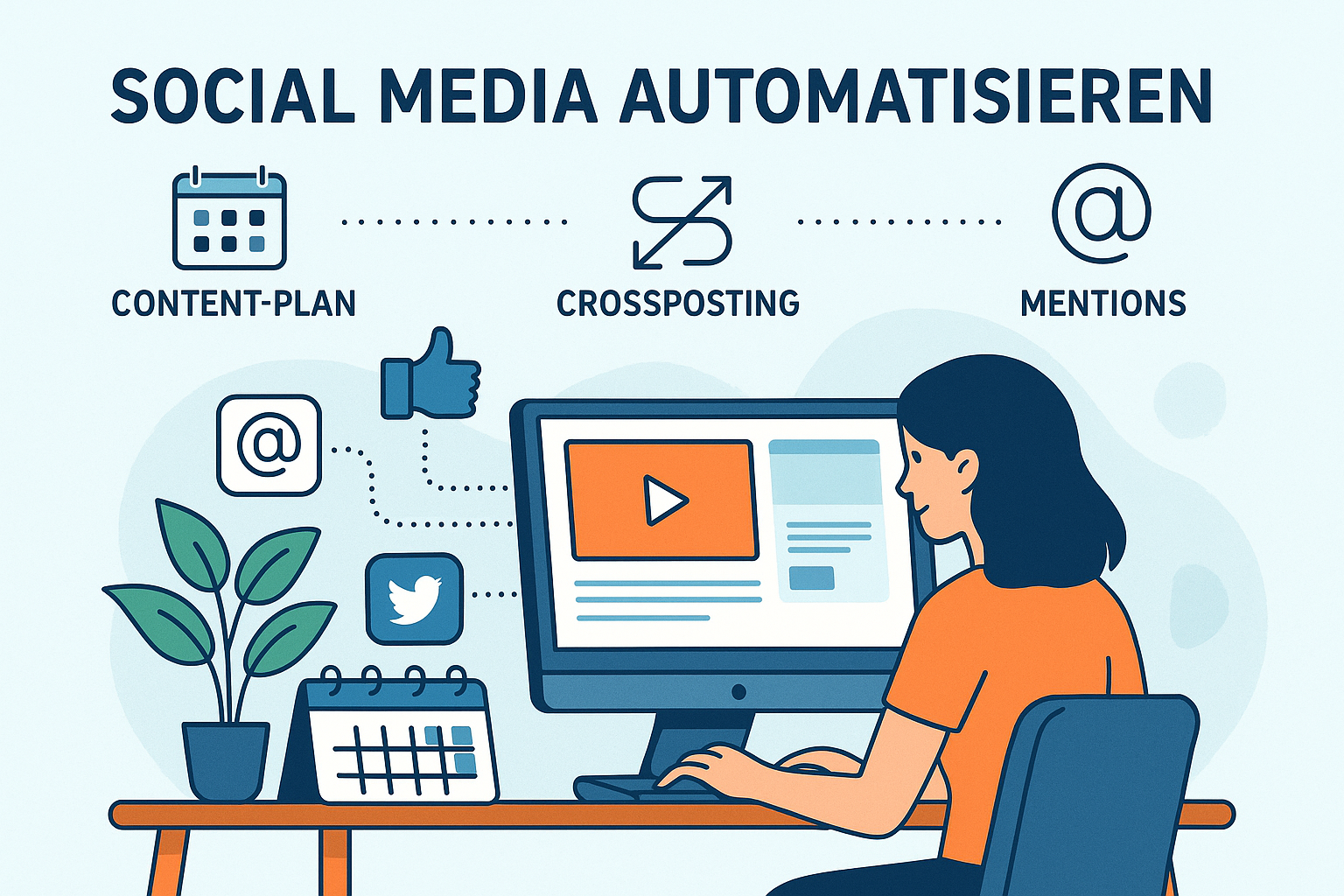
Today, social media is an integral part of professional brand communication. Hardly any company can afford not to be present on channels such as LinkedIn, Instagram or Facebook. But this is precisely the challenge: With every additional platform, new formats such as reels or stories and increasing publication frequency, the effort grows exponentially. Many teams thus get into continuous operation from postings, releases and reports – without a strategic overview.
This is precisely where automation starts. It creates efficiency and structure without losing the personal touch. Routine tasks such as time-controlled posting, re-publishing successful content or synchronisation between multiple platforms can be reliably mapped — This saves time and simultaneously ensures consistency in tonality, timing and brand message.
Implemented correctly, social media automation means no less authenticity, but more freedom for creative and strategic tasks. Instead of dealing with technical processes every day, marketing teams can plan content specifically, analyze performance based on data and manage campaigns in the long term.
This guide shows how social media automation is successful in practice – from structured content planning to intelligent cross-posting through to automated monitoring of mentions. This creates a system that does not replace but supports – and makes communication more sustainable, predictable and effective .
Why Social Media Automation Becomes More Important
Hardly any area in marketing requires as much daily attention as social media. Each platform has its own formats, algorithms and posting times that need to be considered. In addition, planning, approvals, community management, reporting and analysis – tasks that quickly develop into a full-time project. At the same time, customers and followers expect a constant, high-quality presence across multiple channels.
Without automation, this quickly becomes a balancing act: spontaneous contributions compete with planned campaigns, important posts go down in day-to-day business, and valuable data remain unused. This is where social media automation unfolds its greatest benefit – bringing order, predictability and efficiency into a world that is constantly on the move
Instead of manually adjusting each contribution, automation allows runs to be centrally controlled and systematically repeated:
- Timetable: Posts are prepared in advance and published exactly at the right time.
- Reposting successful content: Good performance posts can be reused automatically.
- Data collection & evaluation: Key figures flow directly into reports and show what content really achieves effect.
Companies that structure their social media processes benefit sustainably from three key effects:
- 的 Plantability: Content appears reliable and in constant rhythm – regardless of holiday periods or team availability.
- Consistency: Messages, tonality and visual language remain coherent across channels.
- 的 Data intelligence: Automatic evaluations make it visible which topics generate range and commitment – and where optimization potential exists.
Used correctly, social media automation transforms the hectic posting everyday into a strategically controllable communication system based on data instead of coincidence – and gives teams the space to concentrate again on the essential: creative, relevant content.
What Social Media Automation Really Means
Many understand social media automation only as the automatic posting of content – but in fact there is a much more comprehensive approach behind it. It’s not about “robotizing” communication, but about creating structures that simplify recurring processes and usefully network data.
Realized correctly, social media automation means that all levels of content marketing are connected to each other – from planning through publication to evaluation. Content, processes and key figures interact seamlessly so that the entire process becomes efficient, transparent and comprehensible.
In essence, this approach comprises three key levels:
- Content workflows: Topics, formats and postings are defined and coordinated in advance. Thus it is clear when which content is published, which target group is addressed and how the release takes place.
- Process automation: Publications are executed according to defined rules – contributions are planned, automatically published or shared again when certain conditions are met (e.g. high interaction rate or seasonal reference).
- Data integration: Key figures such as range, clicks or mentions automatically flow back into a central system. This creates an ongoing optimization cycle that shows which content works – and where adaptation is needed.
So social media develops from a succession of individual posts to an intelligent, self-learning system that dynamically adapts. Campaigns adjust their clocking to user activity, reports update themselves, and teams can always understand how individual contributions contribute to the overall strategy.
The big advantage: Marketing teams no longer work in daily business, but on the system. Instead of repeating them manually, they optimize processes and thus create the basis for more output with less effort .
Automation does not replace people – it ensures that they invest their time where it makes the biggest difference: in strategy, creativity and quality.
Automate content planning – from editorial plan to workflow
A successful social media strategy always begins with content planning. It is the organizational backbone of every automation – here it is decided that whether campaigns run smoothly or end in chaosInstead of collecting ideas in confusing tables or chat processes, automated planning ensures that topics, formats and appointments are centrally controlled and implemented in a comprehensible manner.
A digital editorial plan forms the basis for this: it defines wann, wo and in which form content is published. It is not only about scheduling, but also about an intelligent interplay of tasks, releases and data integration .
A typical automated workflow could look like this:
- Ideas Collection & Theme Planning: Content ideas are recorded, categorized and tagged via a common system. This way it is always visible which topics are already edited or still open.
- Memories & Deadlines: Automatic notifications inform editors, designers or responsible parties when deadlines are pending or content is ready for release.
- Status control: Contributions go through clearly defined stages – from “in planning” to “in testing” to “released”. Thus, each team member knows where a contribution is and which tasks are still open.
- Time-controlled publication: Once content is released, the system takes over the publication – optimized by channel, format and time. Hashtags, image sizes and text lengths are automatically adjusted.
This makes the entire process comprehensible and scalable from idea to publication. Teams no longer lose time with voting via email or Excel, but work within a clear, automated framework.
Especially valuable is the possibility to integrate shares, corrections and feedback loops directly into the workflow. Changes are automatically documented, older versions remain available, and notifications inform about new status changes. This not only ensures transparency, but also a reliable quality control .
Thus, content planning transforms from an administrative task into a strategic process that promotes creativity, saves resources and ensures that every release sits perfectly clocked in the overall plan.
Typical workflow of automated content planning
Use crossposting properly – efficiently distribute content
Crossposting is one of the most effective methods to reduce effort in social media management without losing reach or quality. A well-structured contribution can appear on multiple channels with minimal additional effort – adapted to target audience, platform and timing. However, it is crucial: Automation does not replace a strategy. Successful crossposting is based on intelligence, not copying.
Platform differences in crossposting
Many companies make the mistake of publishing the same text on all platforms. However, each community speaks its own language, prefers different content and reacts differently to tonality, hashtags or image styles. Automation only unfolds its added value when it takes these differences into account.
Successful crossposting builds on three core principles:
- 的 Target group differences: LinkedIn requires a factual, user-oriented approach, while Instagram relies more on emotions, visuality and storytelling. Thus, a post may not be duplicated but adapted.
- Formats & Media: A video that performs on TikTok can have a completely different effect on Facebook. Platform-oriented formats – such as square images for Instagram or text carousels for LinkedIn – significantly increase the relevance.
- 🕐 Timing: Each platform has its own activity patterns. While LinkedIn users are active in the morning, Instagram often works better in the evenings. Automated releases can accurately map these time windows.
Automation allows you to control and monitor these parameters systematically. A so-called “master post” serves as a starting point: The content is created centrally and then divided into several variants – such as a short, attention-rich version for X, a visual one for Instagram and a content-focused one for LinkedIn. Thus the message remains consistent, while style, length and format are perfectly aligned with the respective platform.
Another advantage lies in reporting: automated evaluations show which channels achieve the highest reach or the strongest commitment. This enables resources to be specifically bundled where they have the greatest effect. At the same time, such reports help to identify content that is suitable for reposts or content series
Crossposting thus becomes the central efficiency driver in social media marketing – not because content duplicates, but because it is intelligently distributed. Those who strategically plan this approach and implement it technically cleanly achieve significantly more visibility and effect with less effort.
Manage Mentions & Interactions automatically
Social media lives from dialogue – and this is where the biggest challenge lies for many companies. Users comment, like, mention brands or ask questions – often simultaneously on several platforms. Those who handle this flood of interactions manually, risk ignoring important comments or reacting late. An automated recording and management of mentions creates a solution here: It bundles all feedback in one place, prioritizes it according to relevance and ensures uniform, fast communication .
An intelligent system can automatically detect, store and enrich mentions, direct messages or hashtag names with additional information – such as the channel, time stamp or mood (positive, neutral, negative), creating a central dashboard that makes community management clear and predictable.
Typical application examples:
- Instagram comments: A new comment automatically triggers a notification that is displayed in a central tool.
- Marks mentions on X or LinkedIn: These are automatically marked, categorized and added to a to-do list so that no mention remains unanswered.
- FAQ Answers: Recurring questions – such as opening hours, prices or products – can be answered in seconds using predefined text blocks.
The automation does not replace the human dialogue, but provides structured processes in the background. Each message is recorded, categorized and forwarded to the right person or department. Thus support, marketing and sales can be efficiently intertwined without the personal note being lost .
The possibility to analyze interaction data is particularly valuable. Systems recognize patterns: Which topics generate especially many mentions? Where do complaints accumulate? When is the commitment highest? Such findings flow directly back into the content strategy and make communication long-term data-driven and learningable.
Automated mention management is therefore not a luxury, but a decisive factor for professional brand communication. It ensures reaction speed, transparency and consistency – and gives teams the assurance that no comment, no question or mention goes down in noise.
Automated recording and reaction to interactions
Reporting & Optimization – what is automated
In modern social media marketing, it is no longer enough to publish content only – it is crucial to precisely measure their effect and derive improvements from it. Reporting is therefore the heart of professional automation: it transforms data into insights and enables data-based decisions instead of gut feeling.
Automated reporting systems record key figures such as range, clicks, interactions, follower growth and conversion rates across channels – in real time and without manual export of data. Dashboards or automated weekly reports thus provide a clear, up-to-date picture of performance .
Typical key figures that can be automatically evaluated:
- Commitment Rate: Relationship of interactions to range – shows how relevant content is.
- Range & Impressions: How many users have seen and perceived the article multiple times?
- Click & Conversion Rate: How often does content lead to actions, such as website visits or requests?
- Top performer: Which topics, formats or times create the strongest commitment?
By automating these values , they become fast, consistent and comparable – across all platforms. Errors due to manual input are eliminated, and teams gain valuable time for interpretation instead of data collection.
Automated reporting can also be segmented according to target groups, campaigns or platforms. For example, it can be seen that carousel posts on LinkedIn achieve more clicks while videos on Instagram dominate the reach. These insights feed directly into the optimization of future content and create a continuous improvement process .
The combination of regular performance reporting and automated alerts is particularly efficient: If, for example, the engagement rate falls below a defined threshold, a notification is automatically triggered. This allows teams to react quickly and adjust content before a campaign loses effect.
Central key figures for social media reporting
This makes social media not a confusing amount of data, but a strategically controllable system. Automation makes success measurable, reliable and transparent – thus creating the basis for long-term, sustainable growth.
Common errors & best practices
As in any automation project, social media can quickly create errors when strategy, control and quality assurance are lacking. Automation can bring enormous benefits – but only if it is thoughtful, verifiable and flexible The line between efficiency gain and control loss is narrow.
The most common stumbling blocks include:
- Too much automation without control: Social media lives from authenticity. An excessively technized workflow can look sterile if spontaneous reactions or emotional nuances are missing. Automation should support, not replace.
- Missing quality check: Automatically published content must nevertheless be checked editorially. Faulty links, cut pictures or inappropriate hashtags can quickly cloud the professional impression.
- Ignore platform rules: Each API has individual specifications – such as limits for posts, image sizes or authentication. Whoever ignores them risks error messages, limited reach, or in the worst case account lock-ups.
- Unclear responsibilities: If no one assumes overall responsibility for workflows, errors remain undiscovered. Automation needs monitoring, even if it “automatically” runs.
Best practices for stable and secure social media automations:
- Processes think modularly: Rather few, well-tested automations that run reliably than a complex construct that needs to be constantly corrected.
- Plan regular audits: Check workflows at fixed intervals. Samples on published posts help to detect errors early.
- Documentation as default: Describe processes, triggers and responsibilities clearly – especially if several team members are involved. This ensures traceability in case of changes or error analyses.
- DSGVO Note: Social media comments, mentions and messages contain personal data. These must be stored, processed and deleted in accordance with law.
Rightly used, social media automation is not used as a substitute for creativity, but instead as an amplifier 的 It creates the organizational framework in which strategic planning and authentic communication can coexist – efficient, reliable and human at the same time.
Typical sources of error and suitable solutions
From strategy to implementation
The introduction of social media automation is far more than a technical project – it is a strategic change process, which restructures planning, organization and communication. Success does not depend on the tools used, but on whether goals, responsibilities and data flows are clearly defined from the beginning.
Automation always starts with a question: Which tasks should really be automated – and why? Only those who answer this question precisely avoid blind actionism. Instead of digitizing everything at the same time, it is recommended to start with concrete, measurable use cases:
- automated publications at specified times;
- uniform reporting across multiple platforms,
- notifications of mentions or comments;
- structured release processes for contributions.
As soon as these processes work stable, they can be expanded step by step – with mentions management, campaign control, paid postings or automated content variants. This creates a system that grows organic instead of being introduced at once.
It is important that strategy and implementation interact :
- The strategy provides the direction – which goals are to be achieved, which channels have priority, which KPIs count.
- The implementation ensures that these goals are achieved efficiently, transparently and repeatable.
Companies that structure their social media processes in this way gain double: more efficiency in everyday operations and more consistency in brand communication. Messages are more uniform, publications more predictable, reactions faster.
Automation does not replace people – it creates the framework in which teams can work strategically, creatively and resource-saving. When technology takes on routine tasks, there is time for what no software can do: real storytelling, empathy and brand-impressive communication
FAQ: Frequently asked questions about social media automation
- What does social media automation mean?Social media automation describes the use of digital systems to control the planning, publication and analysis of contributions.
processes such as post planning, release and reporting run rule based in the background,
Content appears punctual and platform-friendly,
The results are automatically evaluated and merged into dashboards. - What are the advantages of automated social media management?The main advantages are:
Time saving through automated routine tasks,
consistent brand communication on all platforms,
. better data base for decisions,
More space for strategy and creativity.
Automation makes social media more predictable and efficient – without losing authenticity. - What processes can be automated?Typical fields of application are:
Content planning and editorial calendar,
Crossposting and reusing successful contributions,
Monitoring of Mentions and News,
Automated reporting and performance analysis.
This creates a consistent workflow from design to success control. - How does crossposting work in practice?A master post is created centrally and then adapted to each platform.
The target groups and tonality are taken into account,
Automatically customized formats and hashtags,
的 Release times controlled by channel activity.
This keeps the message consistent, but each contribution is platform-specifically authentic. - What is important in automated community management?Automated systems record mentions, comments and messages centrally.
The answers can be prioritized or prepared with text blocks,
No feedback is lost,
The interaction data provides valuable insights into topics and moods.
Thus, communication remains personal – only more structured and faster. - What key figures are suitable for automated social media reporting?Among the most important KPIs are:
A commitment rate and reach,
Click and conversion rate,
的 Follower growth and top performer by format.
Automated reports show trends at an early stage and support data-based decisions. - What errors should be avoided in automation?Common stumbling blocks are:
To rigid workflows without manual control,
lack of quality control for text and image,
Overautomation without a clear strategy.
Better: small, stable processes with regular audits and clear accountability. - How do I start with social media automation in the company?Start with clearly defined use cases:
的 planned publications and reminder workflows,
automatic mentions tracking,
Weekly reporting by email.
Gradual integration ensures stability, transparency and sustainable success.
Schreibe einen Kommentar zu "Social media automation: content planning, cross-posting and mentions"