

Automated B2B lead nurturing: from MQL to SQL
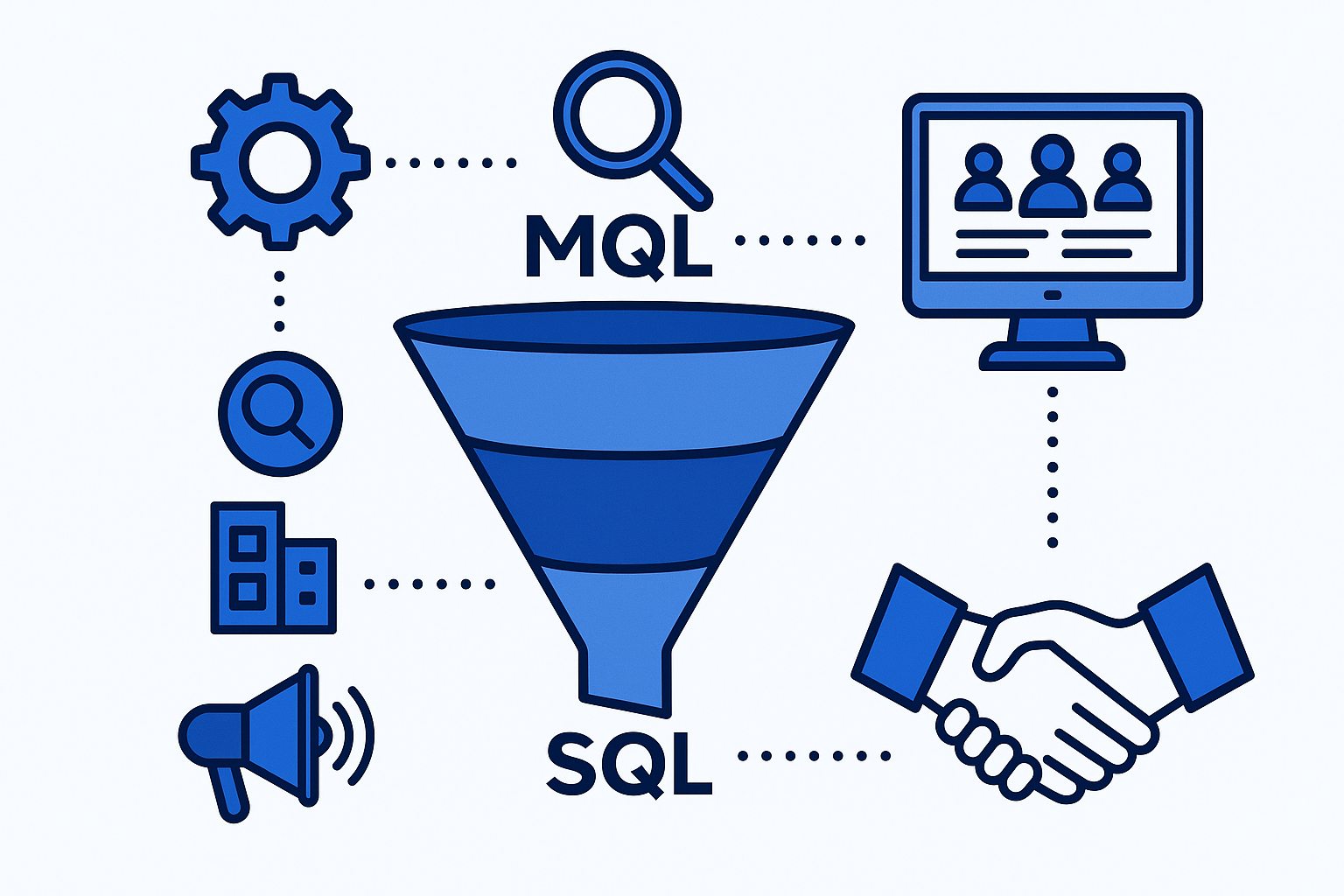
In the B2B, a purchase rarely depends on a single person. Marketing, management, IT and purchasing are often involved. Thus, a purchase decision does not last days, but often 6–18 months. This is precisely why classic newsletter routes fail: they do not respond to real interest, but run bluntly through
Automated lead nurturing works differently. It evaluates how seriously a company deals with an offer — and recognizes the right time when a lead should become from Marketing Qualified Lead (MQL) to Sales Qualified Lead (SQL).
What does that mean in practice?
A lead is not passed on because it downloaded an e‑book. It is passed on if, for example:
- several persons of the same company repeatedly visit the website,
- pricing pages, ROI calculators or case studies are visited,
- a demo date or product documentation is requested;
- Company data (firmography) match the target group.
Such signals are recorded centrally, evaluated and stored as a score. Only when a score or behavior meets defined criteria, the lead automatically goes to distribution — transparent and with complete history ✔
Advantages for both teams:
This creates a transition without friction, without discussions about “lead quality” and without manual lead-hin-and-her. The system decides by means of clear rules — not according to gut feeling.
Why B2B Lead Nurturing must be automated
B2B purchase decisions rarely arise through a spontaneous click. Between first interest and real intention to buy are often weeks to months. The reason are internal hurdles such as:
- Information procurement (What can the product do?)
- Vote with subject areas (Is it technically appropriate?)
- Budget shares (Who will bear the costs?)
- Risk assessment (Does the investment pay for the long term?)
Without support, a company loses many leads not because of lack of interest, but because no one supports the process structured. Exactly at this point automation decides about success or loss.
Automated B2B Nurturing ensures that:
- Signals are detected (e.g. price page + product data sheet + demo request)
- Good content will be delivered, depending on phase & interest
- distribution will only be notified when a lead is really ready to buy
- Leads are automatically regraded when they no longer show interest
Instead of lead cubes, an objective process arises:
Marketing builds interest,
Automation measures maturity,
Sales only takes real chances.
Thus, companies avoid unnecessary sales talks, strengthen the pipeline and increase the SQL share, without having to buy more leads.
What Lead Nurturing really means in B2B
Many companies equate lead nurturing with “a few automated e‑mails”. This is not enough in B2B. A lead will only be available for purchase if Information + Timing + Relevance fits together. Three data sources are required:
Only the combination decides whether a lead “just looks or really wants to shop.
These signals not only flow into e‑mails, but influence the entire setup:
- Scoring in CRM (lead tire rises or falls)
- Sales notifications (account shows buying interest)
- Routing (which distribution takes over which lead)
- Automatic schedules as soon as a defined score is reached
So nurturing does not mean “dispatch content,”
But accompany the purchase process based on data, until a lead becomes comprehensible an SQL (Sales Qualified Lead).
MQL → SQL without marketing buzzwords: What does Sales-Ready mean?
In many companies leads are undefined. Marketing reports “Top-Leads”, the distribution says “that’s no good.” The problem: Nobody knows when a lead is really ready to be sold.
Instead of spongy formulations such as
“MQL = interested and “SQL = ready to buy”
it needs measurable criteria , which both teams accept together.
What is an MQL in practice?
A lead that shows interest but is not yet rated. Typical examples:
- Downloading a whitepaper
- Participation in the webinar
- Registration for the product demo
- Click on a pricing document
👉 An MQL is a lead with recognizable information requirements — but still without confirmed fit and clear buying signals.
What is a SQL in practice?
A lead will only become Sales Qualified Lead if Interests + Match + Action come together.
- Practice formula for which marketing & sales should agree:
SQL = Commitment + Firmography + Action signal
Typical errors that lead to bad SQLs
- Leads will be handed to Sales too early (download only)
- Firmography is ignored (e.g. Freelancer instead of target customers)
- Engagement is measured only by e‑mail clicks
- No downgrading process when interest decreases
👉 A SQL is not a download lead. It’s a lead on purpose.
SQL checklist – common criteria for marketing & sales
The three key triggers that define SQLs really
Whether a lead should really be handed over to the distribution doesn’t decide on a single click or download. SQLs arise only by combining three signal groups that show together: This account wants to buy.
Involvement signals — shows concrete interest
This is not about “newsletter open”, but about actions that indicate maturity. Examples:
的 Engagement signals reveal what a lead is looking for — but not yet whether it fits.
的 Firmography – does the company even fit?
Self-qualifying through data from CRM, IP matching or data providers such as Clearbit or 6sense. Important criteria:
- Firmography shows whether the account is economically relevant.
Account Signals (Intent) – Shows Real Purchase Purpose
Not every “interested” is a buyer. Intent signals show, that something should happen in the company:
Intent shows not only interest, but willingness to buy in the company — not only with one person.
the practice rule: SQLs are created by combination
First engagement + Firmography + Intent = SQL.
A single signal is never enough – the mix makes the deal.
Automate Lead Scoring – Without Point Chaos
Many companies stick lead points together after gut feeling:
+5 for one click, +10 for a download, +30 for a webinar.
That sounds logical, but leads to a problem: The wrong leads end up in the distribution just because they clicked a lot.
Professional lead scoring does not evaluate leads by individual actions, but by quality + intention + activity – and dynamically.
The three score types that each system needs
Only one interested person who fits + shows intention + is active belongs to the distribution.
Score Decay – the score has to fall again
A common mistake: a lead once downloads something and stays “always hot”.
In reality, interest loses value over time.
🕒 Practical solution: The score decreases automatically when there is no signal over X days/weeks.
So only really current opportunities remain in sales.
When does the handover happen to sales?
A lead becomes first to SQL, if all three score ranges are positive:
No fit without intent, no handover.
A lead is usually back into nurturing – not sales.
Automate sales handover – the critical moment
The biggest bug in B2B-Nurturing:
🔊 “Send this to sales, he was in the webinar.
This creates frustrated sales teams, wasted lead costs and “marketing jobs” in CRM.
An automated sales handover ensures that only real opportunities are handed over to distribution – and no one “by accident.”
的 What is passed during handover? (automated & complete)
Distribution immediately knows why the lead is ready to buy – without asking.
What must happen automatically?
Win/loss feedback flows back into the score system and permanently improves nurturing.
the result
- No more lead “blindly pushed over”
- Sales gets context-rich opportunities instead of “e‑mail addresses”
- Marketing optimizes with real feedback instead of gut feeling
Automatically control SLAs between marketing & sales
A SLA (Service Level Agreement) regulates how marketing and sales work together.
In the B2B, this not only means “How fast should sales react?” but which leads can be handed over – and how to deal with them.
Automation ensures that these rules do not need to be discussed, but are automatically observed and documented.
What exactly does an SLA regulate in lead-nurturing?
A SLA prevents leads from being “delivered” or rejected for no reason.
How are SLAs automatically controlled?
For example:
If Sales does not respond after 48 h → Reminder.
After 72 h → escalation + feedback requirement.
Why SLA automation is so important
- Leads do not pass too soon
- Distribution should not ignore leads
- Marketing provides better SQLs with real feedback data
- Feedback flows automatically into score models
- Discussions (“That wasn’t a good lead!”) disappeared
SLA automation ensures measurable quality instead of discussions.
Practice workflows for B2B Lead Nurturing Automation
Lead Nurturing only works reliably when not individual mails are sent , but complete decision-making methods are automated.
The following examples show how signals, firmware and sales handover can play together without manual work:
Workflow A: Demo interest → SQL check → Appointment booking
This workflow only activates if there is real interest in buying.
Destination:
- User opens price sheet or product details (intent signal).
- System automatically checks the firmware (industry, size, country).
- If “Fit + Intent” votes → Lead automatically becomes SQL.
- System proposes appointment options directly (e.g. by mail + calendar link).
- Distribution receives complete transfer dataset.
Result:
Only genuine buyers end up with Sales — including prepared date option.
Workflow B: Whitepaper download → Follow-Up with context
Not every download means buying interest. The context decides.
Destination:
- Users download Whitepaper → Interest.
- Automatic Firmography Check: industry, number of employees, potential.
- With relevant fit, no standard report follows, but tailor-made follow-up content, e.g. ROI calculator, product comparison or case study.
- Engagement with this additional content serves as the second intent trigger.
- Only then does SQL rating + commit follow.
Result:
Whitepaper leads are not quickly sold, but systematically further qualified.
Workflow C: Account Intent (several team visits) → Sales Alert
In the B2B, individuals rarely search — but entire teams.
Destination:
- Several users of a company visit the same feature or price page (intend).
- System recognizes common domain / company IP.
- Fit + Intent → automatic account alert to Sales.
- Sales receives interview recommendation + matching content such as tool comparisons or security checklists.
Result:
Sales speaks properly prepared with a company that already discusses internally.
All workflows have a common rule: No one is “reached” before there is a clear intention.
9) Which tech stack fits which company?
Lead Nurturing does not first depend on the tool, but on the complexity of the purchase process and the amount of leads that really need to be qualified.
The bigger the company, the more important Intent signals, Firmographies and clean lead routing become.
the decision by company size and maturity grade
Where Middleware (e.g. n8n, Make) comes into play
Middleware becomes necessary when:
- Marketing tool
- several stakeholders in the Buying Center need to be identified
- Firmographic scores are not standardized
- Lead routing should be dependent on region, industry, potential
Middleware builds the business logic.
Tools store the data – Workflows decide what happens to it.
Best Practices for Sustainable B2B Automation
Automation only works if marketing and sales speak the same language. The key is not “more automation”, but better decisions through clear rules. These principles ensure that lead nurturing does not become data waste or “marketing spam”.
# Lead handover never without context
Sales may not only receive an e‑mail address.
Each handover must be made automatically with justification:
- what content was consumed
- what signal sales-ready makes
- the role of contact
Sales are not forced to “cold-acquise with other names.”
Intent > Downloads
Downloads show interest – Intent shows intention to buy.
Automation should therefore rate strong action signals higher, e.g.:
- Price/comparison page visited
- technical question asked
- Feature or live demo page repeatedly opened
A price sheet says more than ten blog articles.
Score Decay is mandatory
Nurturing must not work forever.
If a lead X weeks does not show any activity, the score must decrease automatically.
Without decay, overqualified “files” are created that frustrate sales.
Nurturing
B2B-Nurturing accompanies decisions.
- explains benefits,
- removes risks;
- answers technical questions.
No permanent promotion, no mass mail.
Nurturing is supposed to help, not persuade.
Sales feedback is not a “Nice to Have” — it’s mandatory
Automation must force sales to give feedback:
- Why was the lead lost?
- Was he misqualified?
- What role did he have in the Buying Center?
Automatically queried Win/loss feedback improve scoring models and reduce misqualifications in the long term.
Without sales data, no automation gets better — only faster.
Automated B2B Nurturing as a true competitive advantage
Automated nurturing doesn’t just ensure that leads are “processed.” It changes the way marketing and sales work — away from endless discussions about lead quality, to traceable decisions with clear data base.
Companies automating MQL→SQL processes:
✔ pass only really relevant SQLs
No sales team is wasting time with contacts that never wanted to buy.
✔ create transparency instead of ‘lead debates’
Each SQL has a documented justification: Score + Intent + Firmography.
✔ increase completion rates without generating more leads
No more traffic brings sales, but more sales ready leads.
✔ relieve sales with structured handovers
Distribution does not have to do any research, but can sell directly.
dCreative resources flow into product comparisons, ROI computers, case studies — content that accelerates sales processes.
Automation does not provide more leads, but better ones.
And better leads are the strongest growth drivers in B2B.
FAQ: Frequently asked questions about automated B2B lead qualification
- What does automated B2B lead nurturing mean?Automated lead nurturing accompanies interested parties over several touchpoints until they are really ready for distribution.
Signals such as downloads, price interest or team visits will be evaluated, and sales will receive leads only when there is real interest in buying. - What is the difference between MQL and SQL?MQL (Marketing Qualified Lead) = interest, e.g. whitepaper, webinar or product info.
SQL (Sales Qualified Lead) = Interest + Firmography-Fit + concrete action signal.
Only the combination leads to “sales-ready”. - What signals decide whether a lead is ready for distribution?Three triggers are important:
Firmography (industry, size, location)
Engagement (price pages, tools, downloads)
Intent signals (team access, specific questions)
It is only through all three factors that a SQL arises. - How does lead scoring work without rigid point models?Best method: Dynamic scoring with Score Decay.
的 Fit score (company data), Engagement score (content usage) and Intent score (interest in action) are assessed separately.
If the activity decreases, the score will be reduced automatically. - What does an automated sales handover look like?Distribution transfer takes place only with context:
Contact + Roll
. Firmography + potential .
What the lead has consumed
Why it’s sales-ready (signal)
The CRM-Ticket + SLA-Timer + Reminder are generated automatically. - What tools are suitable for automated lead qualification?Common combinations:
• HubSpot + Clearbit + n8n
• Zoho + Pipedrive + Make
• Salesforce + 6Sense + Pardot
The key is not so much the tool, but the logic of workflows. - How do marketing and sales remain coordinated?By automated SLAs:
的 Required fields in CRM for sales feedback
SLA timer for follow-up time
Win/loss data flow back into marketing
So the SQL quality becomes measurable instead of discussable.
Schreibe einen Kommentar zu "Automated B2B lead nurturing: from MQL to SQL"