

What do the sponsored and ugc link attributes mean?
With sponsored and ugc the search engine giant has now introduced Google almost simultaneously two new link attributes. The attribute sponsored applies to pay and advertising links, while ugc is used for links created by users.

© aleksandarfilip – stock.adobe.com – ID #255552654 — Link attributes allow search engines to better evaluate the relevance of links
In this blog post, we want to introduce you to these changes and show you what the new labels mean for website operators and how they affect a link profile. One thing can be said with certainty: The new link attributes will show unexpected ranking effects that may be positive but also negative.
Link Attributes sponsored and ugc at a glance
- The basis of the Google Ranking algorithm are Links. With the attribute nofollow, website operators can devalue individual links for the search engine giant.
- To date, Nofollow-Links were neither considered by the Ranking algorithm nor by the Crawler.
- The nofollow attribute could be used to identify links that should not be recommended, such as advertising links or links posted by users in comments.
- Since September, Google has now inserted two new attributes for links, namely ugc and sponsored: These serve a different purpose than before from the nofollow attribute.
- The attribute adjustments are backwards compatible. This means that no changes have to be made for existing websites.
- From March 2020, the effects of the new attributes can be reflected in the ranking.
The new attributes in detail
The new attributes introduced by Google as a link label have a specific meaning:
- Sponsored — This attribute translates as “financed”: Hereby links should be marked, which are to be regarded as sponsoring, i.e. those in the advertising environment.
- ugc — This tag means “user generated content” and is intended for user-generated content, such as forum post links or links in comments. This attribute should be easier to filter out from users of shared spam. Google recommends that the ugc attribute be removed from trusted Web users and thus benefit from these user posts.
- nofollow — This label can be translated as “do not follow”. This label is mainly used for references to a page that should not be recommended.
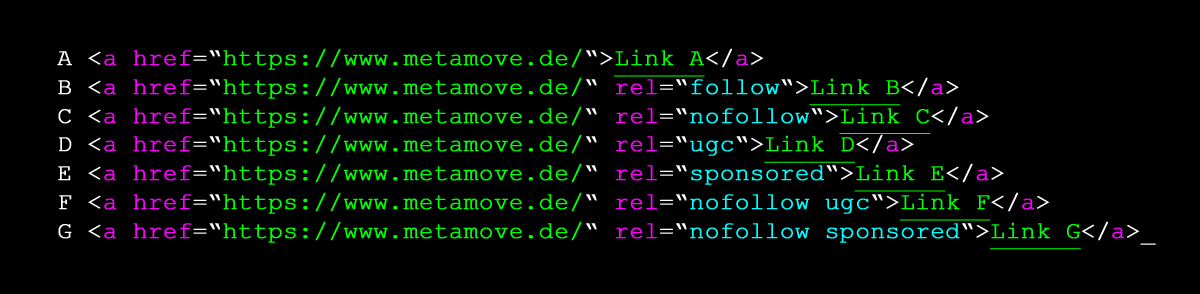
© metamove — The application of the different link attributes
The two new tags as well as the nofollow attribute serve as hints for Google. They facilitate the search engine to better understand and evaluate the numerous information, content and references. Because an increasing number of nofollow links also means more and more online sources for Google which are not to be investigated.
In this context, it should also be mentioned that the new attributes can be combined with each other as well as with the nofollow attribute. For example, a link can also be marked with nofollow ugc if there are user-generated content behind it which is considered irrelevant for Google.
Also sponsored ugc is a possible link identification.
Thus, it becomes more and more complex to manage your own link profile because there are more and more variants to classify the references.
nofollow Linkattribute – major changes from March 2020
The nofollow link attribute can also be used in the future when it comes to identifying references to a specific website that is not recommended for Google. Existing nofollow links are evaluated exactly as new ones. Thus, it is left to each website operator itself whether or not the existing backlinks should be adapted.
However, it can certainly pay off to take a closer look at your own link profile and also consider the nofollow link attributes in the detailed analysis, because from next March 2020 it will be very interesting in this regard: Up to this point, website operators should check internal links on still existing and wrongly set nofollow link attributes. Whoever has used the nofollow link attribute above all to hold back a page from the Google index must reorient themselves not later than spring 2020.
The Metamove experts are very happy to advise you on this topic and support you with an excellent link profile for a powerful search engine optimization and a top ranking.
Feel free to contact us and secure a non-binding offer!
Why are these changes even introduced by the search engine giant?
The search engine giant Google is primarily about better understanding pages. Any reference that goes from a page is a hint to the possibility of using this page in the context of the link environment.
The more pages and references can be specifically classified and evaluated here, the more recommendations Google can make for the ranking of the corresponding page. In principle, it can be said that these link attributes could play a role for the ranking and have to be specifically differentiated between “not relevant, “wanted” or “usergenerated” .
Too big advantages for positioning in the SERPs, however, one should not promise about a revision of the link profile with regard to the new attributes.
From March of next year 2020, the new link attributes will also be used for indexing and crawling as an indication of which references should be considered in Google search and which should be excluded. Whoever voluntarily provides his links with ugc or sponsored can achieve an improved search result.
Link attributes in the application — Attributed links in HTML code
In the application, the old and new attributes look like this:
- A — The default link in HTML (if no attribute is specified, the link is automatically follow):
<a href="https://www.metamove.de/">Link A</a> - B — The follow link in HTML:
<a href="https://www.metamove.de/" rel="follow">Link B</a> - C — The nofollow link:
<a href="https://www.metamove.de/" rel="nofollow">Link C</a> - D — The new attributes – the ugc link:
<a href="https://www.metamove.de/" rel="ugc">Link D</a> - E — The new attributes – the sponsored link:
<a href="https://www.metamove.de/" rel="sponsored">Link E</a> - R & D — Combined values — nofollow in conjunction with the new attributes:
<a href="https://www.metamove.de/" rel="nofollow ugc">Link F</a>
<a href="https://www.metamove.de/" rel="nofollow sponsored">Link G</a>
Schreibe einen Kommentar zu "What do the sponsored and ugc link attributes mean?"