

SSL certificates, data protection and encryption under the GDPR
Archive note. First published on 19 February 2018. The products, interfaces and recommendations discussed here reflect the time of publication.
Anyone who has previously waived an SSL certificate as a website operator or only has partial encryption during the ordering process, for example, should do so with the approaching GDPR. From 25 May 2018, Datenschutz-Groundverordnung (GDPR) will enter into force. In this new EU Data Protection Regulation, new data protection obligations for websites and online shops are summarised. These are particularly relevant for all page operators that store and process data of their users without using a SSL certificate. Contact forms, order forms and newsletter applications are primarily affected and must be encrypted by an SSL certificate at the latest 25 May 2018 according to the new law.
Many pages registered in Germany are still not secured by SSL-Encryption , although this has been mandatory since 2016 with the entry into force of the Telemedia Act . However, this should definitely be done in order not to violate the new law at the end of May , because with the new GDPR also the penalty level is drastically increased in case of non-compliance of the regulation . In the following we summarize the most important points for you what the SSL certificate and the reliable fulfilment of the new GDPR have to do with each other and what they should pay attention to now.
In order to make sure on time, you should already take care of an SSL certificate for your website or online shop. We are happy to help with the topic of data protection, SSL encryption and obligations by the GDPR. Just call us at 089 / 680 980 57 or send us a request!
Encryption with security certificate: SSL and TLS briefly explained
The secure encryption of user data is usually done via an SSL certificate. By filling out contact forms or orders in online shops, many people know the term itself as a user. With the entry into force of the GDPR, mainly online retailers also have to consciously deal with the topic SSL certificate. In the meantime, two variants appear up, SSL and TSL and with you also the question: Is there a difference between SSL certificate and TLS certificate? Actually, the term SSL (Secure Sockets Layer) is now outdated and has been officially replaced by TLS (Transport Layer Security). Generally speaking, the name SSL is still frequently used, but thus means the current TLS version. This is an encryption protocol that ensures the security of data transmission between a computer and a server. If, for example, a contact form without an SSL certificate is filled and sent, third parties may use security gaps and arrive at personal data unintentionally. Especially this problem will be solved when ordering forms from Online Shop has been made mandatory for payment connections, for private persons, for payment purposes.
Advantages of the SSL certificate: Secure customer data and meet GDPR
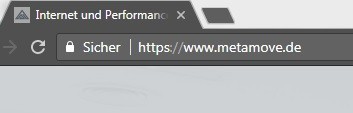
Identify security at a glance in the browser.
So far, it was only recommended to: Customer data in the online shop In order to encrypt contact forms using an SSL certificate, the GDPR will be obliged to provide clear data protection from May 2018. Those who take care of an SSL certificate for their own website in good time will naturally have the advantage of acting in compliance with rules and not risking any penalties. In addition, encryption is more than a burdensome obligation, it also has a positive effect on various other factors. The user or customer will be guaranteed confidence and security when dealing with his personal data and of course also communicates. Furthermore, since 2014, SSL-protected pages have been better ranked by Google, i.e. are “remunerated” for responsible handling of customer data. As of July 2018, Google also intends to identify unsafe connections in its own Chrome browser. Thus, visitors will be explicitly informed if this is an unencrypted connection. Therefore, the use of an SSL certificate pays off multiple times. Online presence can be found better by a small procedure, becomes more user-friendly at the same time, is protected from hacker attacks and data claws and is clearly marked as “safe”.
Encryption obligation by GDPR — you should pay attention to this with the topic SSL certificate!
To provide your website with an SSL certificate is the first and probably most important step for a secure transfer of user data. The GDPR also contains further provisions on how you need to design your website to ensure integrity and discretion in relation to processed data. If you are not sure whether your website already has an SSL certificate, you will see it as quickly as possible in the form of your URL. As a rule, the URL of your website takes place “http” the abbreviation “https” if your page has a security certificate. Generally, check the offer of your website and get an overview of all processes of your homepage that process personal data. Such processes can be all possibilities of registration or registration, as well as contact and order forms, and newsletter offers. These processes must be protected and protected.
What to do if your website does not yet have full SSL encryption? The implementation of this mandatory security measure can – depending on how your website is built up – take place quite quickly, partly also with free SSL certificates. We will be happy to help you with this topic and accompany you on the way to data security. Just call us at 089 / 680 980 57 or send us a request!
Schreibe einen Kommentar zu "SSL certificates, data protection and encryption under the GDPR"